

How Die Lubricants Impact Cycle Time in High-Volume Casting
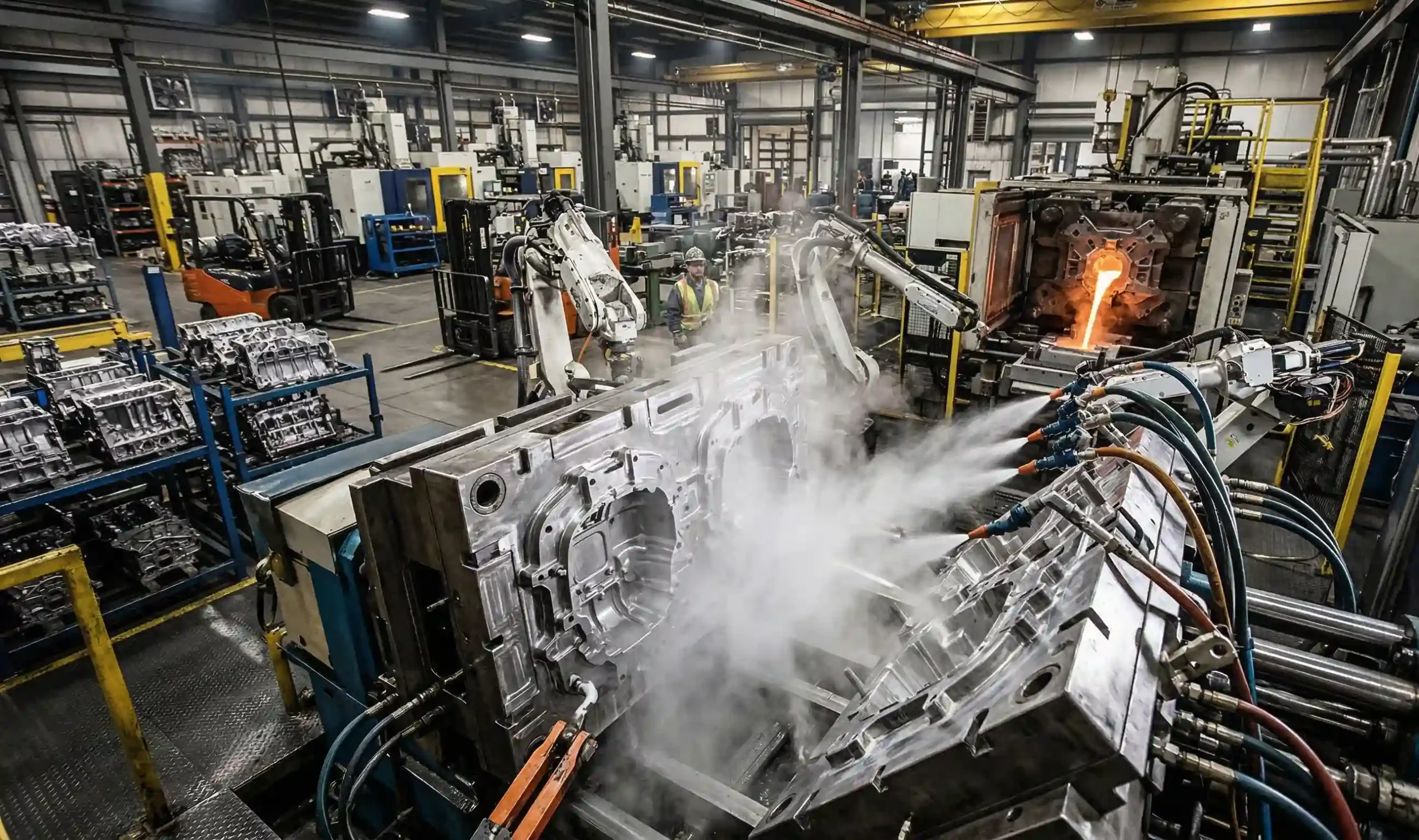
In high-volume casting, productivity is significantly dependent on the rate at which each production cycle is completed.
Manufacturers are continually seeking ways to minimize the time it takes to complete a production cycle while at the same time ensuring that the quality of the products is high and the die life is maximized.
One of the key, but least understood, factors that affect production efficiency is the die casting lubricant used in the process.
When the right die-casting mold release lubricant is used, along with die lubrication systems, manufacturers can minimize production time, thus enhancing efficiency in production operations.
From heat transfer to part release, die lubricants affect the die casting process, particularly the time it takes to produce parts in a high-volume process.
Understanding how lubrication works and why proper die lubricant composition matters is essential for achieving consistent and efficient production.
Understanding Cycle Time in High-Volume Casting
Cycle time is defined as the total time taken to execute a single casting cycle. This means that it covers all aspects of the casting cycle, starting from the injection of molten metal into the mold and ending with preparing the mold for the next cycle.
The casting cycle consists of:
- Die closing
- Injection of molten metal into the mold
- Cooling and solidification
- Die opening
- Ejection of cast parts
- Lubrication of the mold for the next cycle
In terms of productivity, it has been seen that even if a few seconds are reduced from each cycle, it can have a major impact on productivity, especially when dealing with large quantities. This is where selecting the right die casting lubricant becomes highly important.
Now let’s discuss the key functions of die lubricants during casting.
Key Functions of Die Lubricants in Casting
The lubricants are applied to the die surface for efficient casting operations. The main purpose of the lubricants is to develop a protective layer between the molten metal and the mold.
Functions of Die Lubricants
- It is to reduce friction
Die lubricant compositions reduce friction between the molten metal and the mold surface. This helps in the smooth flow of the molten metal into the mold cavity.
- Prevent adhesion of metal
A good-quality mold release die-casting lubricant prevents the adhesion of the metal to the mold surface, which helps in the smooth ejection of the metal from the mold.
- Regulate die-surface temperature
Die lubricants maintain the temperature of the mold surface. This prevents the mold from getting heated, which might affect the casting process.
- Protect the die surface
Die lubricants provide protection to the mold surface, which increases the life of the expensive molds.
Also Read: How to Choose the Right Die Casting Release Agent
How Die Lubricants Affect Cycle Time
The type and performance of the lubricant used in the casting process may directly affect the following factors, which determine the cycle time.
- Faster part release
Perhaps the greatest advantage of using an effective die casting mold release lubricant is the quick release of the parts from the mold. When the casting sticks to the mold, additional time is usually needed to remove the casting from the mold. This additional time increases the cycle time of the process.
When using effective lubricants, the casting is released from the mold because of the thin layer of the lubricant that forms between the casting and the mold. This way, the mold moves quickly to the next cycle.
- Improved heat management
Temperature management is one of the most critical factors in the casting process. When the mold gets too hot, the cooling time increases, which may lead to defects in the casting process.
When the composition of the mold lubricant is effective, the heat is well distributed across the mold. This way, the molten metal solidifies uniformly. This leads to faster cooling times, which in turn leads to faster cycle times.
Reduced Die Cleaning and Maintenance
Inadequate lubrication may cause problems such as metal build-up, soldering, or carbon deposits on the die surface. Such problems necessitate machine shutdowns for cleaning or maintenance.
A good-quality aluminum die-casting lubricant ensures that the molten aluminum does not stick to the die surface. This minimizes the chances of build-up on the die surface, keeping the die surface clean for long periods.
By minimizing machine shutdowns for maintenance, manufacturers can ensure uninterrupted production.
Importance of Proper Die Lubrication Systems
The effectiveness of lubrication does not depend only on the lubricant but also on the lubricant’s application. Modern die lubrication systems have been developed to apply lubricant accurately and reliably to the critical areas of the die.
Die lubrication systems may include an automated spray unit for applying lubricant in an exact amount.
There are several advantages of an automated lubrication system, which include the following:
- Consistent coverage
Each cycle receives the same amount of lubricant. This ensures the stability of the process.
- Reducing spray time
Effective spray patterns ensure that the lubrication process takes the least amount of time between cycles.
- Less material consumption
Accurate lubricant application ensures that less lubricant is wasted, resulting in less buildup.
- Better process control
Automated lubrication systems enable manufacturers to control the spray timing based on the process requirement.
Die lubrication systems, if optimized correctly, can ensure the right balance between lubrication and cooling, which is important for maintaining high-speed cycles.
Lubrication Challenges in Aluminium Die Casting
Aluminum die casting is used in various industries, ranging from the automotive and electronic industries to the manufacturing of household items.
However, aluminum has some difficulties in the lubrication process due to its high casting temperature and adhesive properties on metal surfaces.
For the lubrication process in aluminum die casting, a lubricant has to be chosen that is capable of providing the necessary release properties and protection against extreme temperatures.
In the presence of molten aluminum, the die will get soldered if it sticks to the metal surfaces, leading to a longer downtime.
A lubricant is used, which acts as a thermal barrier between the molten aluminum and the die, thus avoiding direct contact between the two.
Role of Die Lubricant Composition
The formulation of the lubricant is of prime importance in ensuring the proper functioning of the lubricant in casting processes.
An ideal formulation of a die lubricant should possess lubricating, cooling, and separating properties, as well as the ability to withstand high temperatures.
The general formulation of a lubricant may include the following components:
- Water-based carriers
- Graphite or synthetic lubricating materials
- Heat-resistant materials
- Anti-soldering materials
- Wetting agents
The combination of all the components of the lubricant formulation helps in creating a thin film on the surface of the die. The film should be thick enough to prevent the adhesion of metals and thin enough to ensure proper heat transfer.
If the formulation of the lubricant is not proper, it may evaporate too quickly or leave residues, both of which may result in longer cycle times
Final Thoughts
Cycle time is a vital element in the determination of productivity in high-volume casting operations. A die casting lubricant is essential in the promotion of part release, die temperature, and the elimination of problems like metal adhesion and die wear.
Together with the effective application of die lubrication systems and the right composition of the lubricant, manufacturers are able to attain smoother operations and faster cycle times.
Advanced lubrication systems, like those developed by Chem Trend, help manufacturers attain the optimal casting efficiency and product quality.
By using the best quality die-casting mold release lubricant and aluminum die-casting lubricant, casting operations are able to attain optimal productivity and stability in high-speed operations

 Argentina
 Brasil
 Canada
 Česko
Česko
 CIS (excluding Russia)
 Deutschland
 España
 France
 Italia
 México
 România
 Polska
 Türkiye
 United Kingdom
 United States
 Việt Nam
 中国
中国
 한국
한국
 日本
日本