

Rotational Molding Advantages and Disadvantages Explained for Manufacturers
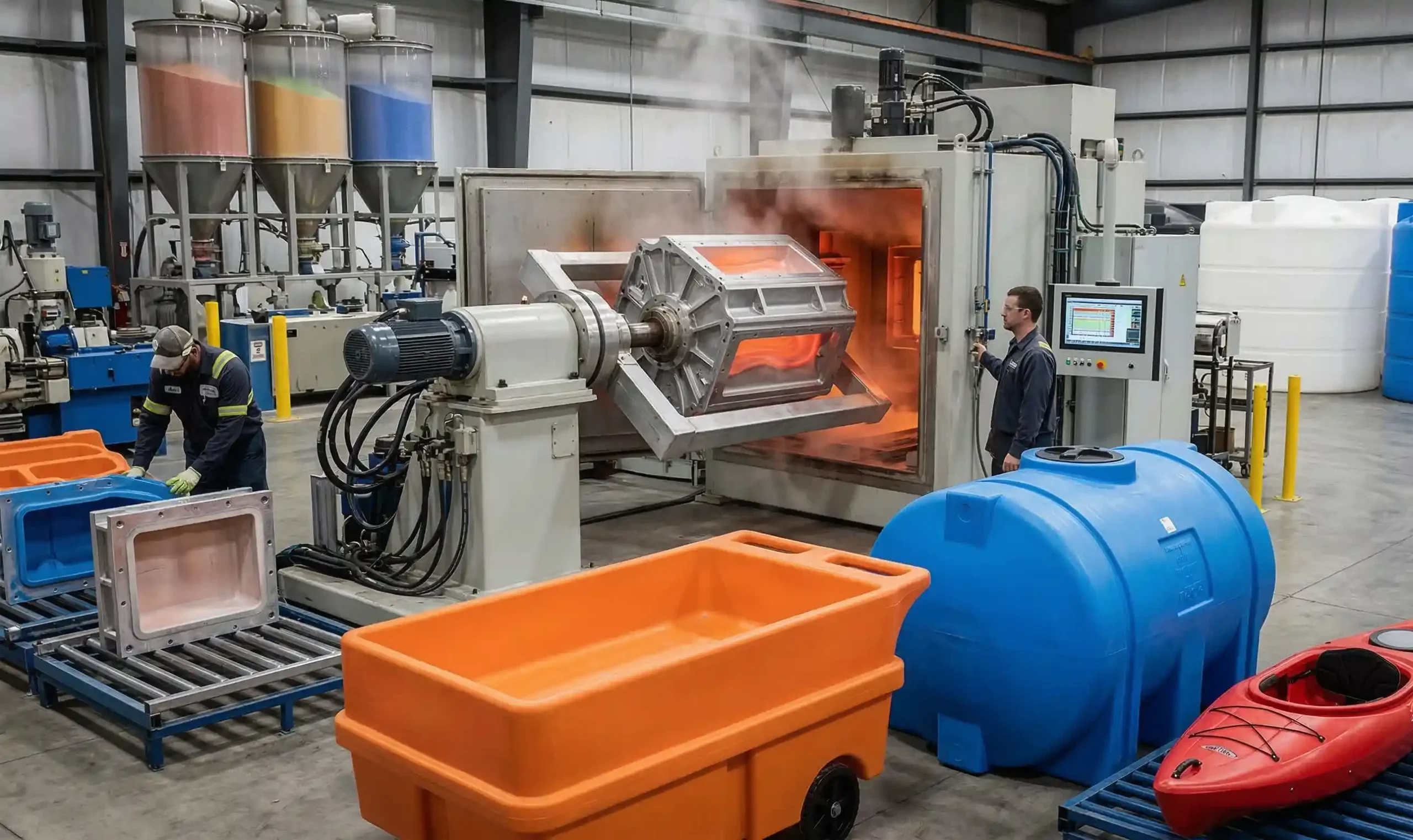
Plastic manufacturing processes have a vital role to play in the production of various products. From storage tanks to consumer products, manufacturers are using various molding processes to develop strong products.
Among the processes, rotational molding has become incredibly popular among various industries. Understanding the various advantages and disadvantages of rotational molding is crucial for manufacturers who want to adopt the best possible manufacturing process for their products.
The process of rotational molding has several benefits, but there are some disadvantages too. This blog will cover the basic concept of rotational molding and the importance of using rotational molding for various manufacturing processes.
What Is Rotational Molding?
The manufacturing process used in making hollow plastic products is known as rotational molding, which is also referred to as rotomolding.
This involves the use of a mold in which the powdered plastic material is loaded. The mold is then rotated at a slow speed on two different axes.
As the mold rotates, the plastic material melts and uniformly covers the mold. This continuous rotation ensures that the plastic material is uniformly distributed over the mold.
After the melting process, the mold is cooled while rotating at a slow pace in order to maintain the uniform thickness of the product.
After the completion of the manufacturing process, the product is removed from the mold, and the desired hollow plastic product is ready. This product does not contain any joints.
Among the materials used in this manufacturing process is rotational-molded polyethylene, which is known for its durability and ability to withstand harsh environmental conditions.
How Rotational Molding Equipment Works
The production process involves specific rotational molding machines that are able to control the heating, rotation, and cooling of materials.
A typical system of rotational molding includes the following:
- A rotating mold that rotates with arms that move in two directions
- A heating chamber that rotates with the mold as the plastic melts
- A cooling station that allows the molded part to cool
- A demolding station that allows for removal of the finished part
Unlike other molding techniques, rotational molding does not involve any pressure to mold the plastic. Gravity and rotation are what are used to distribute the melted plastic uniformly over the surface of the mold.
Also Read: Plastic Moulding Methods and Their Key Applications
Rotational Molding Advantages and Disadvantages
Manufacturers can weigh the advantages and disadvantages of rotational molding as they decide on this method of manufacturing their products. As discussed, rotational molding has many advantages, but it also has its own set of disadvantages.
Advantages of Rotational Molding
- Uniform wall thickness
One of the greatest advantages of rotational molding is that it can manufacture products with uniform wall thickness.
As discussed above, during the process of rotational molding, the mold rotates continuously while being heated. This results in an even distribution of plastic over the mold’s surface.
This leads to strong products that are neither too thin nor too weak.
- Strong and durable products
Products manufactured through rotational molding are known for their durability. In rotational molding, no joints or edges exist in the mold, which reduces the probability of failure.
This is one reason rotational molded polyethylene is used for manufacturing products that need to withstand harsh weather. Products like water tanks, fuel tanks, industrial bins, etc., benefit greatly from this durability.
- Design flexibility
Manufacturers are able to produce complex hollow shapes with custom rotational molding techniques. Inserts, fittings, and layering can also be included as part of the final product.
This allows engineers to merge various parts of a product into one, which can reduce costs and improve product efficiency.
- Cost-effective tooling
Compared to other plastic manufacturing techniques, rotational molding tools are relatively simple and cost-effective.
This allows manufacturers to utilize rotomolding as a means of producing medium-run or large products that may otherwise require expensive tooling costs.
Reduced tooling costs can greatly reduce production costs for manufacturers.
- Ability to produce large hollow parts
Rotational molding can produce hollow parts that are often too large to produce with traditional manufacturing techniques.
rotational molding applications include storage tanks, kayaks, playground equipment, and industrial containers.
Because rotational molding does not require pressure, manufacturers can produce larger molds without needing expensive machinery.
Disadvantages of Rotational Molding
Though there are many advantages in the process, manufacturers must consider the advantages and disadvantages of rotational molding before adopting it as a method of manufacturing.
- Slower production cycles
Generally, the process of rotational molding involves a longer cycle compared to other processes like injection molding.
The process of heating and cooling is necessary in order to melt and solidify the plastic material. This process is not very efficient in cases of high-volume manufacturing processes.
- Limited material options
The process of rotomolding is based on the use of polyethylene materials. Rotational molded polyethylene is one such material. Though the material is highly durable, there are certain disadvantages in the process.
- Less precision for small parts
Rotational molding is best for large hollow parts but cannot offer the same level of precision for small parts. Processes like injection molding could be better for parts that need to have very tight tolerances.
- Higher material consumption
Parts made through rotational molding need to have thick walls to have the strength they need, which could mean that the process could end up consuming more materials compared to other molding processes.
This could lead to a slight increase in the costs of the product.
Also Read: Rotational Molding vs Blow Molding
Rotational Molding vs Blow Molding
Another comparison that can be drawn in plastic manufacturing involves rotational molding and blow molding.
Although both processes are applicable in manufacturing hollow plastic products, the techniques applied are quite different.
In blow molding, a plastic tube that is heated is inflated inside a mold to create hollow objects like bottles and containers. Blow molding is commonly applied in packaging industries.
On the other hand, rotational molding creates hollow objects by rotating powdered plastic inside a heated mold. By doing so, manufacturers can create thick and durable objects.
Therefore, blow molding can be applied in manufacturing lighter objects, whereas rotational molding can be applied in manufacturing heavy objects.
The Role of Custom Rotational Molding in Manufacturing
Modern industries need specialized plastic products that have been manufactured for specific purposes. It is at this point that custom rotational molding has been able to make a significant impact.
Custom rotomolding enables manufacturers to make modifications to the design of the molds, the thickness of the materials, and the product’s design based on specific needs.
For instance, manufacturers have the option of adding ribs, inserts, and multiple materials to the products to improve their functionality.
Modern advancements in rotational molding equipment have enabled the process to produce products with precision, thus enhancing the versatility of the rotomolding process.
Improving Efficiency in Rotational Molding
As manufacturing technologies are constantly improving, companies are always looking for a way to improve efficiency and the quality of the products.
Innovations in mold design, automation, and material handling are constantly improving the rotomolding process.
Improved equipment for rotational molding allows for temperature control and consistency in the rate of rotation, thus improving the quality of the products while reducing defects.
These innovations are constantly improving the competitive nature of rotational molding compared to other manufacturing processes.
Final Thoughts
Today, rotational molding has proven to be a vital manufacturing technique for the production of strong and durable hollow plastic products. By understanding the rotational molding advantages and disadvantages, manufacturers will be able to determine the suitability of the technique for their production requirements.
Through rotational molding, manufacturers will be able to derive various benefits such as the production of hollow articles of uniform wall thickness, strong structures, and cost-effective tooling.
Additionally, rotational molded polyethylene materials have excellent strength and resistance for a variety of industrial uses.
With the increased need for durable plastic products and specific rotational molding processes, many manufacturers are also looking at custom rotational molding solutions to cater to specific design needs.
With the help of technologies and solutions provided by companies like Chem Trend, manufacturers can look at enhancing the overall efficiency and quality in rotational molding processes.

 Argentina
 Brasil
 Canada
 Česko
Česko
 CIS (excluding Russia)
 Deutschland
 España
 France
 Italia
 México
 România
 Polska
 Türkiye
 United Kingdom
 United States
 Việt Nam
 中国
中国
 한국
한국
 日本
日本