

Rotational Molding vs Injection Molding: Which Process Delivers Better Part Quality?
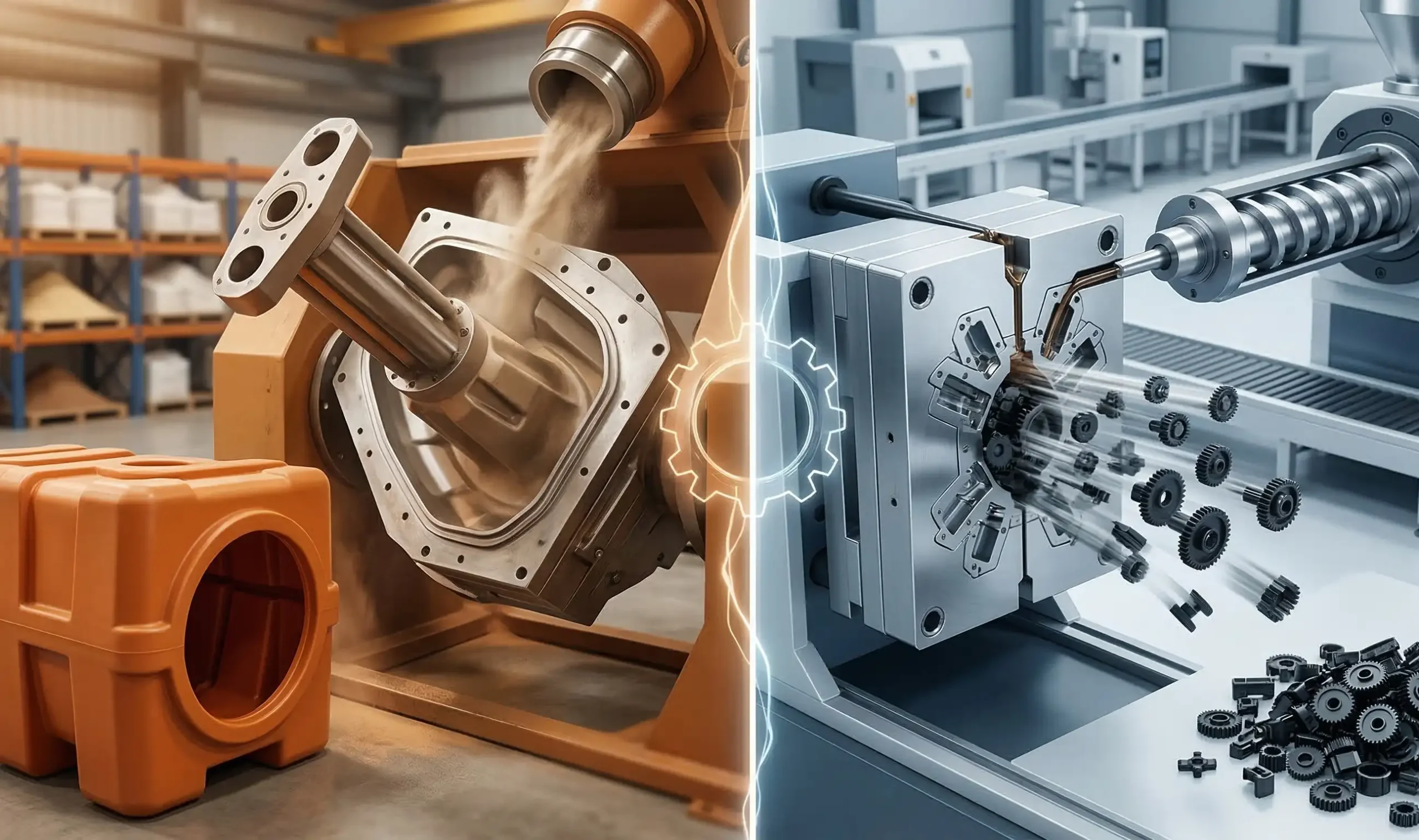
In the contemporary manufacturing of plastics, the selection of the appropriate molding process is critical in ensuring the quality and efficiency of the final product.
Among the numerous manufacturing techniques for producing plastics, the debate of the advantages of using the rotational molding process compared to the injection molding process is one of the most common in the selection of the appropriate process for producing plastic components in the industry.
Although the rotational molding and injection molding processes are popular in the manufacturing sector, especially in the production of automotive components and packaging materials.
These two techniques differ significantly in their operations and the benefits associated with their use in the production of the final product.
Within this blog we will discuss rotational molding vs. injection molding with their advantages and find out which one produces the best product in the final outcome.
Understanding Rotational Molding
Rotational molding is one of the most popular manufacturing techniques for plastics. In this technique, powdered plastics are filled inside the mold, which rotates slowly along two axes.
At the same time, the mold is also heated. As the mold rotates, the plastics inside the mold melt and cover the inside surface of the mold evenly.
Rotational molding is one of the most popular techniques for manufacturing strong products such as tanks, containers, playground equipment, etc.
As the plastics cover the inside surface of the mold evenly, the products produced through this technique have strong structural integrity.
Thus, rotational molding is one of the most popular techniques for manufacturing plastics, making the comparison between rotational molding vs. injection molding an important one.
Understanding Injection Molding
Injection molding is one of the most popular methods for manufacturing solid plastic parts. In injection molding, the melted plastic is forced into the closed mold under high pressure.
The melted plastic fills the mold completely, cools, and solidifies into the desired shape. As the cooling process is complete, the mold opens, and the molded part is released.
Injection molding is commonly used for manufacturing parts such as electronic parts, automotive parts, medical parts, packaging parts, etc. It is particularly useful for making intricate parts in extremely large quantities.
Injection molding is very different from rotational molding, as the former uses high pressure for injection.
Also Read: Different Types of Injection Moulding Explained
Rotational Molding vs Injection Molding: Key Differences
When discussing rotational molding vs. injection molding, the differences lie in the way the materials are processed, the type of parts that each process can create, and the quality characteristics of the parts.
Injection molding consists of high-pressure injection into molds to create solid parts with precise tolerances. Rotational molding, on the other hand, is based on the creation of hollow parts with uniform wall thickness.
Another difference between the two molding types is the cost of the molds. Injection molds have to be highly engineered, which makes the molds very costly. Rotational molds, on the other hand, are easier to create.
The quality of the parts produced also depends on the definition of the term.
Advantages of Rotational Molding and Injection Molding
| Factors | Rotational Molding | Injection Molding |
| Wall thickness | Produces uniform wall thickness because the mold rotates during heating. | Wall thickness is controlled by mold design enabling very thin and precise sections. |
| Internal stress | Parts have very low internal stress since the process does not use high pressure | High pressure during injection may create internal stress if not carefully controlled. |
| Design flexibility | Suitable for large hollow parts and complex shapes using custom rotational molding techniques | Ideal for small, detailed components that require tight dimensional tolerances. |
| Tooling Cost | It is one of the greatest advantages of rotational molding, as the molds are less expensive. | Tooling is more expensive |
| Speed | Production cycles are slower | Very fast production cycles |
Which Process Delivers Better Part Quality?
In terms of rotational molding vs. injection molding, it is important to note that, depending on what is required, part quality is significantly dependent on the product needs.
For instance, if a manufacturer requires precision parts with thin walls and intricate features, then injection molding is likely to produce better results.
This is because, with injection molding, high pressure is applied, which ensures accurate parts.
In other instances, however, if a manufacturer requires parts that have impact resistance, durability, and hollow features, then rotational molding is likely to produce better results.
In fact, custom rotational molding solutions have been used by various manufacturers in various industries simply because they produce hollow parts that have no seams and joints.
As technology improves, new rotational molding techniques have been developed, which have ensured that manufacturers enjoy improved design flexibility and product performance.
The Role of Advanced Manufacturing Solutions
Both rotational molding and injection molding are continually evolving with new technologies that help increase productivity while maintaining quality in the molded parts.
Material advancements, mold design, and process support systems are helping manufacturers optimize their processes.
Companies such as Chem Trend are providing specialized solutions that help support the molding processes, thus enabling manufacturers to optimize their processes.
The new technologies are playing an important part in maintaining the quality of the molded parts in both injection molding and rotational molding processes.
In the manufacturing industry, where high productivity is the key to success, the use of process support technologies is helping manufacturers achieve the results with the molds.
Also Read: What is Injection Moulding – Process, Benefits and Vital Tips
Final Thoughts
The decision between rotational molding vs. injection molding depends on several factors, including the product’s design, the production volume, and the performance demands.
Injection molding is the best option for making precise parts, which are smaller in size, have precise tolerances, and have high rates of production.
On the other hand, the advantages of rotational molding make it the best option for making larger hollow parts that have high durability and wall thickness.
Blow molding vs. rotational molding demonstrates that each manufacturing process is designed to meet the needs of the products made through each process.
Today, manufacturers have more options than ever before, thanks to the innovative rotational molding technology that is available, along with the custom rotational molding capabilities.
By understanding the benefits of each process, manufacturers can take advantage of the advanced process solutions offered by Chem Trend to ensure that their products have the quality they need while still maintaining the efficiency of the process.

 Argentina
 Brasil
 Canada
 Česko
Česko
 CIS (excluding Russia)
 Deutschland
 España
 France
 Italia
 México
 România
 Polska
 Türkiye
 United Kingdom
 United States
 Việt Nam
 中国
中国
 한국
한국
 日本
日本